
 Sometimes, all you want to do is enjoy a peaceful evening in your backyard. But this is not always possible at the height of mosquito season in Louisiana. Does it seem like the mosquitoes will keep coming in endless waves no matter how many you swat or your bug zapper zaps? The trick is eliminating them before they fully develop – killing mosquito larvae.
The key to killing mosquito larvae is making their water habitat unconducive to development, either by dumping out the water or using an additive. Mosquitoes are easy to spot in their larval stage. Killing them at this stage before they have the ability to fly is a great way to suppress the overall mosquito population on your property, interrupt the lifecycle, and finally get some relief.
In this article, we’ll explain:
- How to Kill Mosquito Larvae
- How to Identify Larvae
- Why Stagnant Water Is Crucial to the Mosquito Lifecycle
View the video overview here.
Call now or fill out the form below & a team member will reach out shortly!
The audio above covers the major takeaways from the article.
What’s the Best Way to Kill Mosquito Larva?
Did you know that mosquito bites are part of the mosquito reproductive cycle? Female mosquitoes require a blood meal to lay their eggs, so each bite plays a role in reproduction, increasing the number of mosquitoes around your home. Every time you feel a bit, the mosquito flies off to find stagnant water where she can lay dozens or even hundreds more eggs, perpetuating the lifecycle.
By targeting eggs and larvae in the water before they mature, you can dramatically reduce the number of adult mosquitoes, which decreases their overall reproduction capacity, reducing future infestations.
Here are the best ways to do that:
- Dump the Water Out: If you find an old toy filled with water and mosquito larvae (also known as “wrigglers”), the easiest solution is to simply dump it out. This will likely kill most of the larvae, but not necessarily all. Larvae need very little water to develop. Even the small amount you dumped out could be enough.
- Dish Soap or Shampoo: If you can’t dump the standing water, add a small amount of liquid dish soap or shampoo per gallon and gently mix. This reduces the surface tension of the water, causing mosquito eggs and larvae from staying afloat and causing them to sink and drown.
- Oil: Spread a thin coating of olive or vegetable oil across the surface of standing water. The oil forms a barrier that cuts off oxygen, killing mosquito eggs and larvae. Do not use oil in ponds or birdbaths since it may harm fish, birds, and other wildlife.
- Vinegar: Pour apple cider vinegar into small water containers, such as birdbaths, making up roughly 15 percent of the total volume. This can disrupt larval growth, although it tends to be less effective at eliminating mosquito eggs.
How to Identify Mosquito Larvae
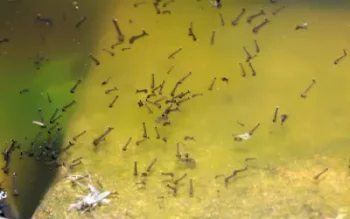
Mosquito larvae are very small and easy to miss if you’re not looking for them. If you are looking for them, they’re fairly easy to identify. It helps to know that they’re also sometimes called “wrigglers” because they tend to make a sideways wriggling motion in the water.
What Do Mosquito Larvae Look Like?
Recognizing mosquito larvae is an essential step in stopping mosquito populations from growing. Often called “wigglers,” mosquito larvae swim with a distinctive side-to-side motion.
They look like tiny worms and vary in color from beige to brown. Their ability to survive in a tiny amount of water makes them easy to overlook – unless you’re looking for them. Here’s how to spot them:
- Worm-like Body: They have long, soft, segmented bodies that look like tiny hairy worms.
- Size: They are very small, usually ranging from 1 millimeter up to about half an inch (12 mm) long, depending on how close they are to transforming into pupae.
- Color: They are generally semi-translucent, appearing off-white, yellowish, brown, or dark grey.
- Distinct Sections: Even though they don’t have legs, you can easily spot three distinct body regions: a hard, rounded head; a slightly wider, bulbous thorax (middle section); and a long, segmented tail-like abdomen.
- Hairy Appearance: Their bodies are covered in tiny, fine clusters of bristles or hairs extending from their segments.
- Tail “Snorkel” (Siphon): Most species have a distinct, hard little tube sticking out of their tail end. They use this like a snorkel to breathe oxygen from the air.
- Upside-Down Posture: Because of that breathing tube, the most dead-honest giveaway that you’re looking at mosquito larvae is their posture: they hang upside down from the surface of stagnant water, with their tails touching the top and their heads pointing downward.
- Sudden Diving Movement: If you approach the water or cast a shadow over them, they will rapidly “wriggle” their entire bodies in an S-shaped motion to dive down toward the bottom for safety.
Many confuse them with tadpoles, but tadpoles are larger and have smooth tails. Mosquito larvae, in contrast, have segmented bodies and stay close to the water’s surface for oxygen. Knowing the difference helps you act quickly to prevent infestations.
Where Are the Most Common Mosquito Breeding Grounds?

Spotting larvae early is one of the best ways to prevent larger infestations. Promptly destroying breeding grounds helps reduce future mosquito activity. Homeowners in Louisiana benefit greatly from this strategy due to the region’s warm conditions.
Mosquitoes can multiply in surprisingly small amounts of water. Identifying and removing these areas quickly keeps larvae from growing into adults. Common places to check include:
- Marshes and Creeks: If your property backs up to a marsh or wetland area, you’re at a natural disadvantage when it comes to mosquito defense.
- Clogged Rain Gutters: Trapped leaves block water flow, creating hidden, elevated pools.
- Corrugated Downspout Extensions: The flexible, bumpy plastic ridges trap water long after rain stops.
- Potted Plant Saucers: Plastic trays beneath flower pots hold shallow water right next to shaded foliage.
- Old Tires: The interior shape traps rainwater perfectly, and the dark rubber creates a warm, insulated breeding zone.
- Bird Baths: Stagnant water left unchanged for over a week becomes an open nursery.
- Tarps & Covers: Sags and wrinkles in covers for grills, firewood, boats, or cars collect shallow puddles.
- Unscreened Rain Barrels: Open collection bins allow adult mosquitoes free access to lay eggs.
- Buckets & Wheelbarrows: Any open utility container left sitting right-side up.
- Kiddie Pools & Toys: Plastic wading pools left filled, or forgotten toys with hollow spaces that catch rain.
- Tree Holes: Natural hollows in trunks and large branches trap water in shaded, protected areas.
- Pet Water Bowls: Outdoor dishes left unrefreshed for more than 7 days.
- Pool Covers: Standing water that accumulates on top of sagging winter covers.
- Trash Bins: Outdoor garbage and recycling cans without drainage holes or with loose lids.
Why Stagnant Water Is Key to Mosquito Egg Survival
Getting rid of stagnant water is a highly effective method for controlling mosquitoes. Why? To put it simply, mosquito larvae cannot survive without water. Female mosquitoes deposit their eggs in still water, and once hatched, the larvae stay submerged, feeding on organic matter as they grow through multiple stages. They eventually become pupae before emerging as adult mosquitoes prepared to continue the cycle.
How Emptying Water Kills Mosquito Larvae
Even tiny amounts of water can support mosquito larvae, so careful attention is important. Regularly emptying containers this way prevents mosquitoes from multiplying and stops larvae from returning.
Here’s how:
- They Suffocate on Land: Even though mosquito larvae live underwater, they cannot breathe underwater because they don’t have gills like fish. Instead, they have a tiny breathing tube (called a siphon) at their tails that acts just like a snorkel. To breathe, they have to hang upside down in a pool of water so the tip of their snorkel can poke through the surface into the air. When you dump the water out, they lose the deep pool they need to hang from. Once they are stranded on the ground, dirt and mud block their tiny snorkel tubes, and they suffocate because they can no longer pull in air.
- They Dry Out (Desiccation): Mosquito larvae have incredibly soft, wet bodies built exclusively for life in the water. The moment you pour them out onto dry concrete, grass, or dirt, the sun and air rapidly evaporate their body moisture. Because they cannot walk or crawl on land to find a new puddle, they dry out and die in a matter of minutes.
- They Get Crushed and Eaten: When you flip over a container, the sudden rush of water and gravity physically knocks the tiny larvae around, which can easily injure or kill them. If the fall doesn’t do it, the local ecosystem finishes the job. Ants, beetles, spiders, and birds view stranded larvae as a delicious, easy-to-reach snack.
Bottom line: Mosquitoes need stagnant water to develop. By dumping the water, you strip away the only environment where their breathing snorkels work and leave them completely defenseless against the dry air and predators.
How Fast Do Mosquito Larvae Turn Into Adults?
The mosquito lifecycle is rapid. Mosquito eggs can hatch within a day or two. During this short stage, they are highly sensitive, and eliminating stagnant water can stop them from ever becoming larvae.
After hatching, larvae develop quickly, reaching adulthood in one to two weeks, which is why prompt action is so important.
Experts in mosquito control know the breeding sites that are commonly missed by homeowners. Their services help manage mosquito populations and keep outdoor spaces more pleasant and easier to enjoy.
Keep Mosquitoes Away with Ja-Roy Pest Control
Dealing with mosquito problems on your own can be difficult, but Ja-Roy Pest Control is ready to help. Residents in Louisiana rely on our team to find and treat hidden breeding sites. We address every mosquito hotspot, preventing larvae and eggs from developing into adults, keeping your yard enjoyable and ready for family time.
Enjoy your outdoor spaces without worrying about mosquitoes. Reach out to Ja-Roy Pest Control and let our experts handle the problem for you.
Back to Mosquito Exterminators – Control – Removal


